
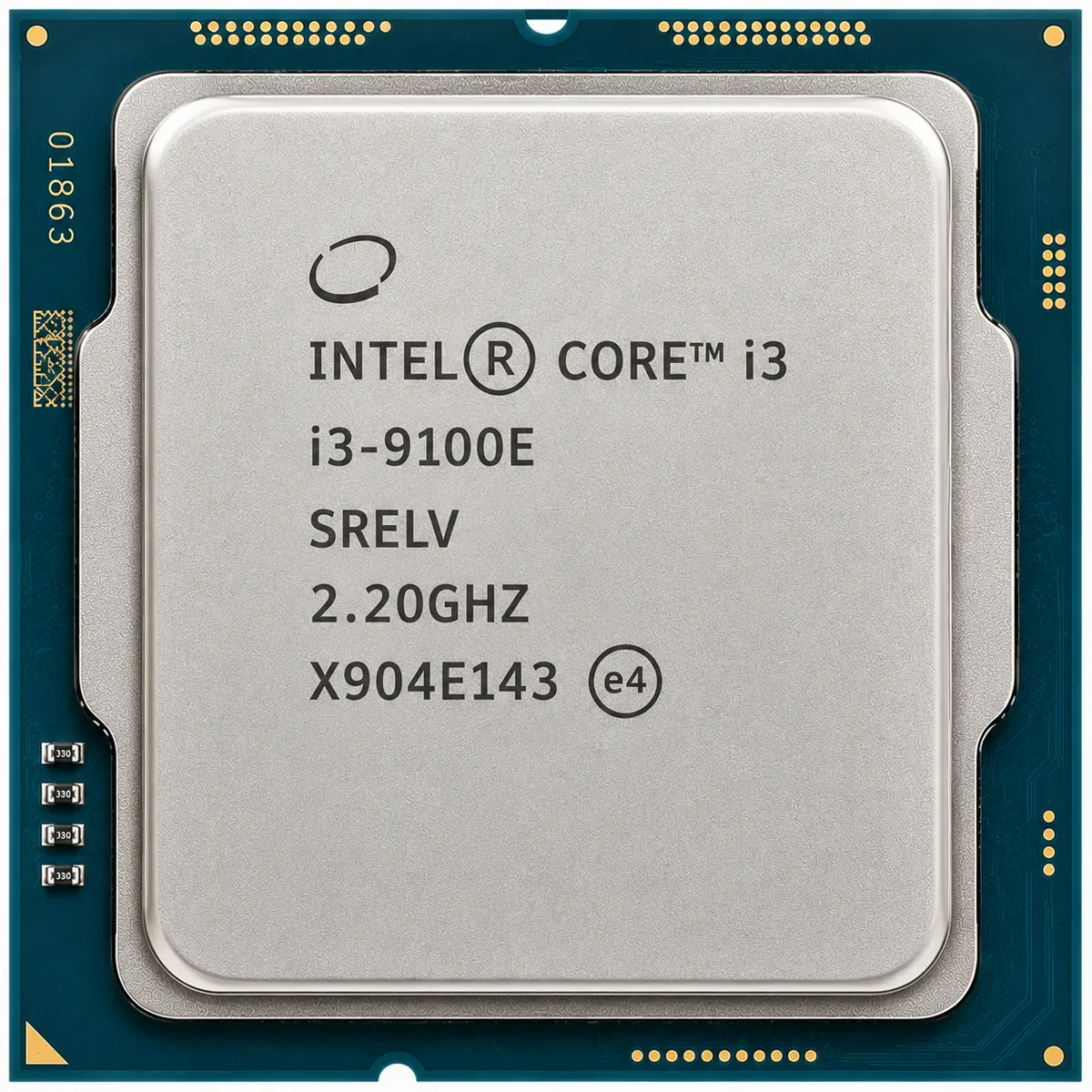
Intel Core i3-9100E 9th Gen Embedded Processor, 4-Core, LGA1151
The Intel Core i3-9100E is an embedded processor with four cores and four threads, built on Intel's 9th generation Core architecture, codenamed Coffee Lake Refresh. It runs at a base frequency of 3.10 GHz and reaches 3.70 GHz under Turbo Boost, backed by 6 MB of Intel Smart Cache within a 65 W thermal envelope. It installs in an FCLGA1151 socket on Intel 300 series boards, supports dual channel DDR4 at up to 2400 MT/s, and unlike the i5 and i7 parts of the same generation it supports ECC memory. As an embedded SKU it is offered on Intel's extended availability terms, which is what makes it suitable for designs that have to stay buildable for years.
About Intel →Specification
Additional details
Compatibility and integration considerations
The FCLGA1151 socket is shared with the 6th and 7th generation parts, but this processor needs an Intel 300 series chipset and will not boot on a 100 or 200 series board despite fitting the socket, so verify the chipset rather than the socket when ordering against an existing platform. Boards that shipped before this generation launched may need a BIOS update before they will post. Memory runs in dual channel DDR4 at up to 2400 MT/s with a 64 GB ceiling, which is both slower and half the capacity of the 9th generation embedded i5 and i7 parts, so check the memory kit when substituting across tiers. ECC is supported on this part, which is the main reason to choose it over the i5 and i7 embedded parts of the same generation, but ECC also needs chipset and board support to actually function, so confirm the whole platform rather than the processor alone. Integrated Intel UHD Graphics 630 requires display outputs on the board, and cooling should be rated for 65 W.
Typical use cases
This processor is the entry embedded quad core of its generation and suits industrial PCs, control cabinets, kiosks and instrumentation where the workload is modest but the platform has to stay orderable and, in the cases that matter, has to catch memory errors. It is the cheapest way into ECC in this family, since the faster embedded i5 and i7 parts drop it entirely.