
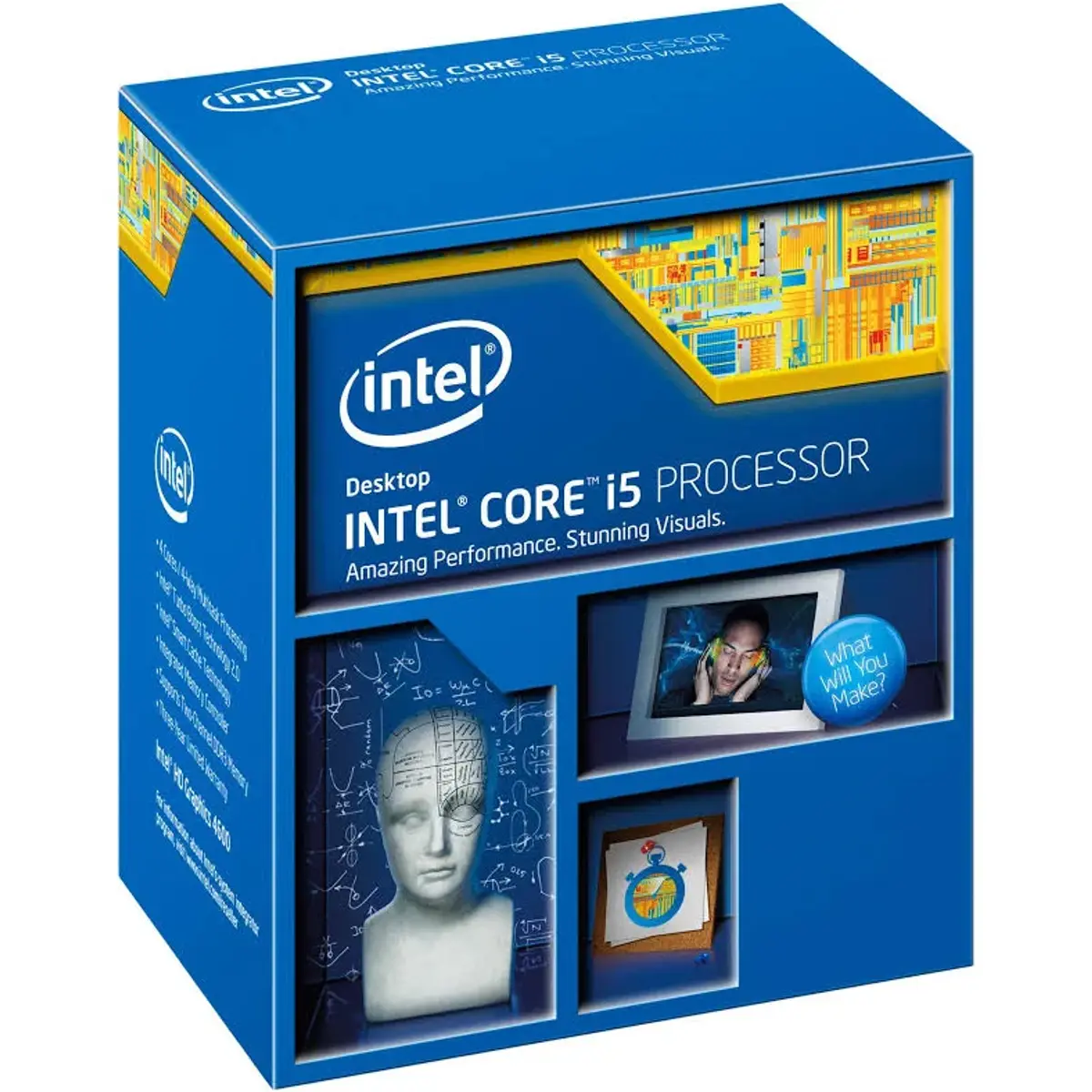
Intel Core i5-4570S 4th Gen Desktop Processor, 4-Core, LGA1150
The Intel Core i5-4570S is a desktop processor with four cores and four threads, built on Intel's 4th generation Core architecture, codenamed Haswell. It runs at a base frequency of 2.90 GHz and reaches 3.60 GHz under Turbo Boost, backed by 6 MB of Intel Smart Cache within a 65 W thermal envelope. It installs in an FCLGA1150 socket and supports DDR3 memory at speeds up to 1600 MT/s, which suits it to compact systems where thermal headroom is limited.
About Intel →Specification
Additional details
Compatibility and integration considerations
The FCLGA1150 socket carries Haswell and its Broadwell refresh, so this processor runs on 8 series chipsets such as H81, B85, Q87, H87 and Z87, and on 9 series boards such as H97 and Z97 once the board has a current BIOS. It does not fit the LGA1155 boards of the previous generation. Memory runs in dual channel DDR3 at up to 1600 MT/s with a 32 GB ceiling, and ECC is not supported. The S suffix marks the 65 W version of the i5-4570, which draws considerably less than the 84 W standard part and suits chassis with limited airflow. Integrated Intel HD Graphics 4600 requires display outputs on the board, otherwise a discrete card is needed.
Typical use cases
This processor appears in small form factor desktops, thin clients, industrial PCs and digital signage players where the power envelope matters more than peak performance. Demand is almost entirely replacement and fleet maintenance, since the platform predates current sockets and the systems built on it are long past their original design cycle.