
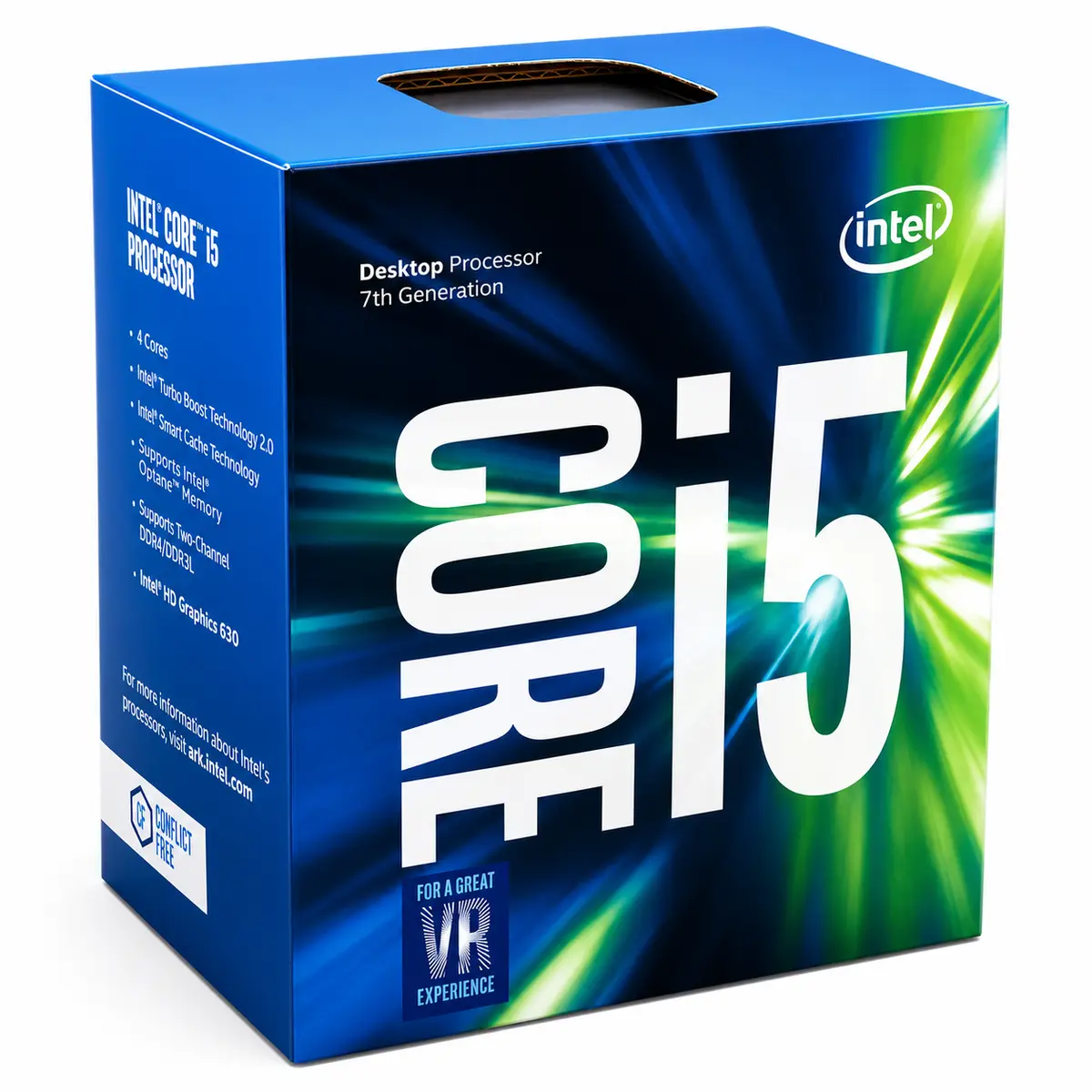
Intel Core i5-7500 7th Gen Desktop Processor, 4-Core, LGA1151
The Intel Core i5-7500 is a desktop processor with four cores and four threads, built on Intel's 7th generation Core architecture, codenamed Kaby Lake. It runs at a base frequency of 3.40 GHz and reaches 3.80 GHz under Turbo Boost, backed by 6 MB of Intel Smart Cache within a 65 W thermal envelope. It installs in an FCLGA1151 socket and supports either DDR4 at up to 2400 MT/s or DDR3L at up to 1600 MT/s, which suits it to mainstream desktop and industrial systems.
About Intel →Specification
Additional details
Compatibility and integration considerations
This processor runs natively on Intel 200 series chipsets such as B250, H270 and Z270, and on 100 series boards only after a BIOS update, so confirm the board's processor support list and firmware revision before ordering against an existing platform. The FCLGA1151 socket is also used by the 8th and 9th generation Core parts, which require 300 series boards and cannot substitute for this one. Memory runs in dual channel as either DDR4 at up to 2400 MT/s or DDR3L at up to 1600 MT/s with a 64 GB ceiling, and ECC is not supported, which is the main difference from the embedded parts of the same generation. Integrated Intel HD Graphics 630 requires display outputs on the board, and cooling should be rated for 65 W.
Typical use cases
This processor is common in office desktops, thin clients and industrial PCs that were qualified on Kaby Lake and need four cores without threading. Most demand is replacement and fleet maintenance, either swapping a failed unit or keeping a validated image running on hardware that would otherwise have to be requalified on a newer socket.