
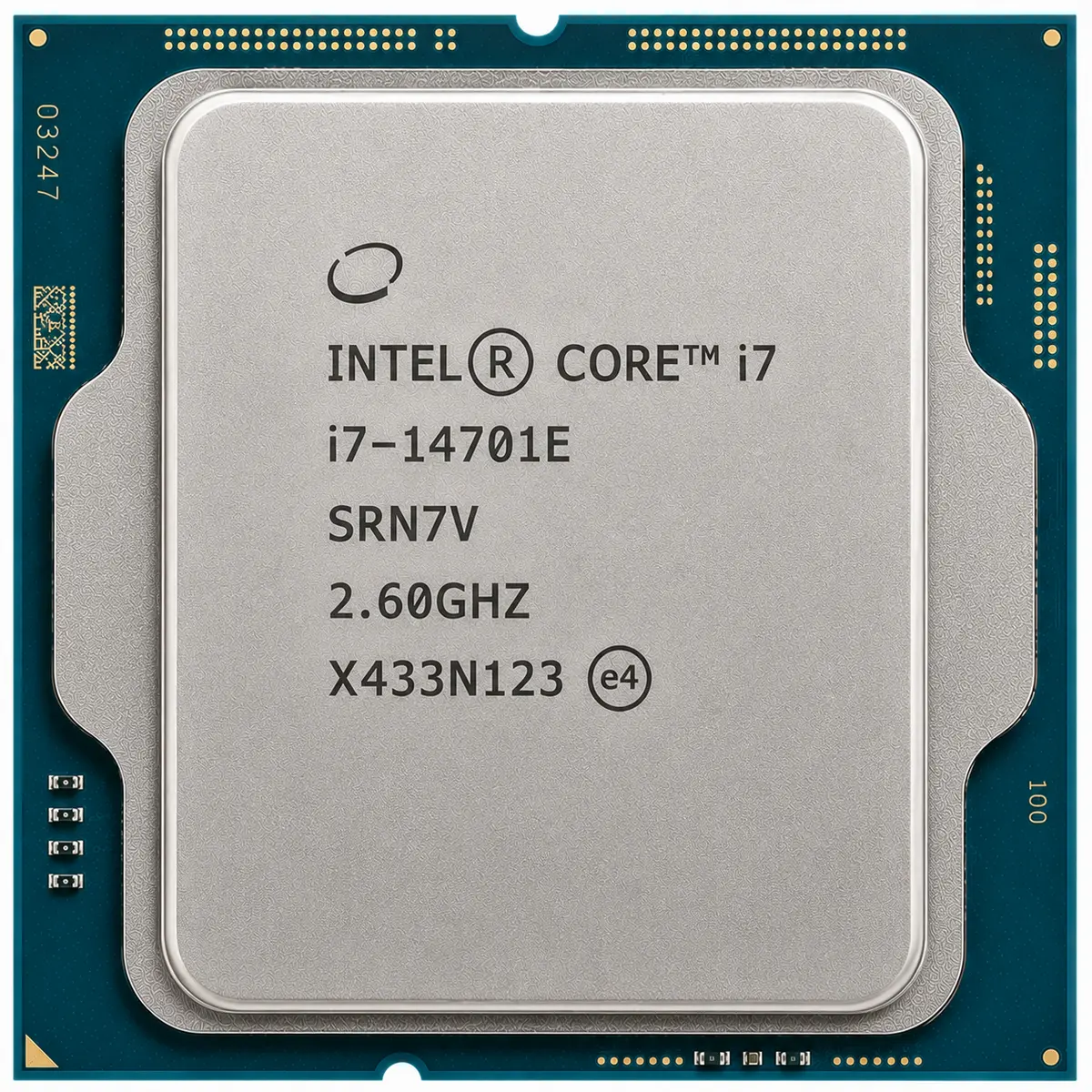
Intel Core i7-14701E 14th Gen Embedded Processor, 8-Core, LGA1700
The Intel Core i7-14701E is an embedded processor with eight performance cores and sixteen threads, built on Intel's 14th generation Core architecture, codenamed Raptor Lake. It has no efficient cores, so every core is a performance core, running from 2.60 GHz to 5.40 GHz under Turbo Boost, backed by 33 MB of Intel Smart Cache within a 65 W base power envelope. It installs in an FCLGA1700 socket, takes either DDR5 or DDR4 up to 192 GB, and supports ECC memory. As an embedded SKU it is offered on Intel's extended availability terms, which is what makes it suitable for designs that have to stay buildable for years.
About Intel →Specification
Additional details
Compatibility and integration considerations
This processor uses the FCLGA1700 socket, so it shares no platform with the FCLGA1151 and FCLGA1200 parts elsewhere in this family and cannot be dropped into an older board. Read the core count carefully before specifying this part. Intel publishes eight cores and sixteen threads with no efficient cores, alongside 33 MB of Intel Smart Cache. Anyone reading the cache figure and assuming the desktop i7-14700 layout will be wrong by twelve cores and twelve threads. The 16 MB of L2 corresponds to the eight performance cores, so the part is internally consistent on cores even though the L3 figure is carried over from a larger configuration. Intel lists Thermal Velocity Boost and Turbo Boost Max Technology 3.0 at the same 5.40 GHz as the max turbo, so there is no additional headroom above that figure. Memory reaches 192 GB, and ECC is supported subject to chipset and board support. Integrated Intel UHD Graphics 770 requires display outputs on the board. Intel publishes only a Processor Base Power figure for the embedded SKUs and no Maximum Turbo Power, so there is no official peak power number to size a supply or a VRM against. The desktop siblings do publish one, but those figures belong to different parts and should not be borrowed. Size against the datasheet.
Typical use cases
This processor suits edge and industrial workloads that want the highest sustained per core speed on this socket, such as low latency control, single stream inference and per core licensed software. Against the 13th generation embedded i7 it trades eight efficient cores for a much higher base clock in the same 65 W envelope, which is the right trade for latency and the wrong one for throughput.