
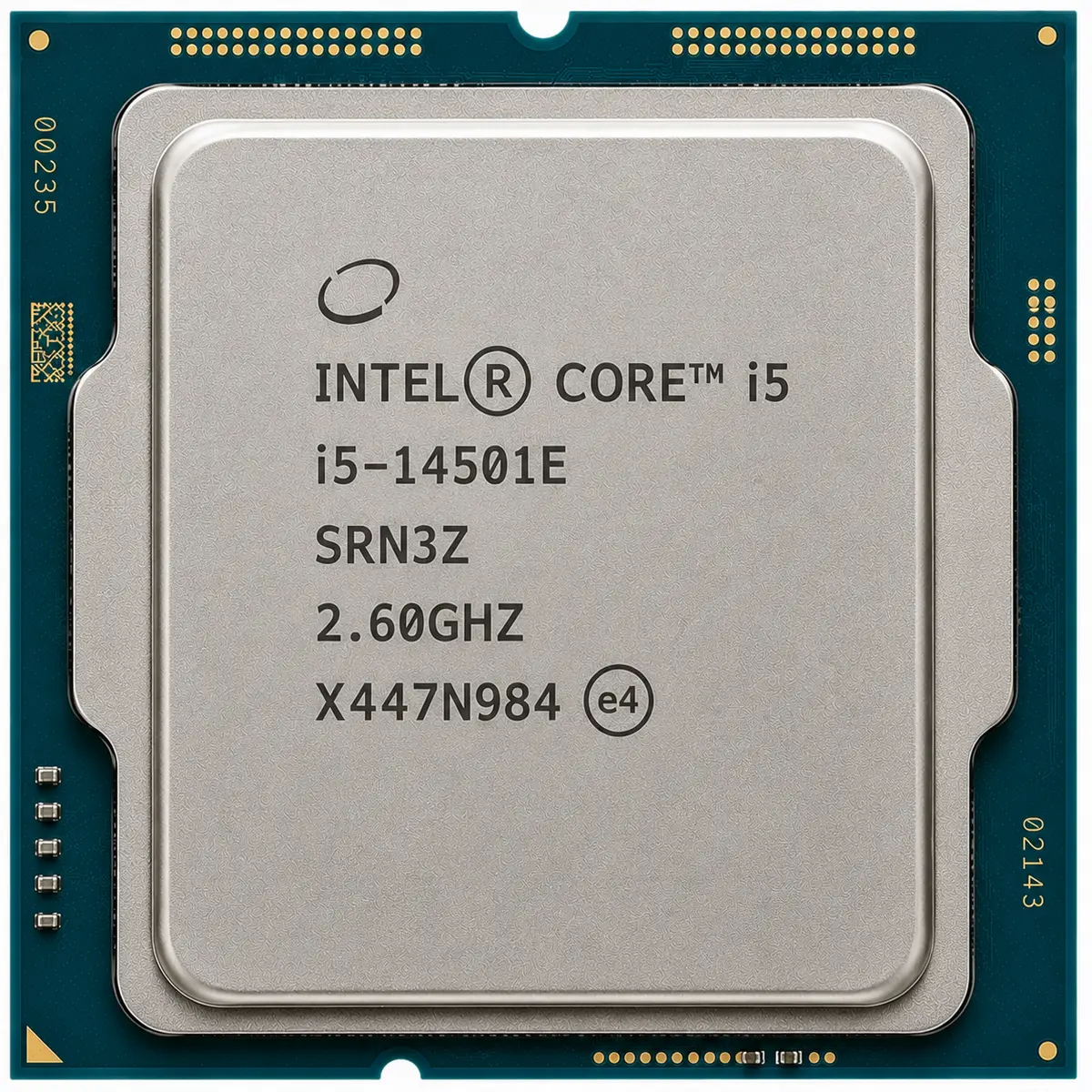
Intel Core i5-14501E 14th Gen Embedded Processor, 6-Core, LGA1700
The Intel Core i5-14501E is an embedded processor with six performance cores and twelve threads, built on Intel's 14th generation Core architecture, codenamed Raptor Lake. Unlike the 12th and 13th generation parts in this family it has no efficient cores at all, so every core is a performance core, running from 3.30 GHz to 5.20 GHz under Turbo Boost, backed by 24 MB of Intel Smart Cache within a 65 W base power envelope. It installs in an FCLGA1700 socket, takes either DDR5 or DDR4 up to 192 GB, and supports ECC memory. As an embedded SKU it is offered on Intel's extended availability terms, which is what makes it suitable for designs that have to stay buildable for years.
About Intel →Specification
Additional details
Compatibility and integration considerations
This processor uses the FCLGA1700 socket, so it shares no platform with the FCLGA1151 and FCLGA1200 parts elsewhere in this family and cannot be dropped into an older board. The core layout is the thing to check before substituting. This is a performance core only part, six cores and twelve threads, with the efficient cores disabled, so it is not comparable to the desktop i5-14500 and it carries far fewer cores than the 13th generation embedded parts. What it gains in exchange is clock: a 3.30 GHz base against 1.30 GHz to 1.90 GHz on the hybrid parts, which makes sustained single thread and lightly threaded work markedly faster. The 24 MB of Smart Cache is retained from the full die even though the efficient cores are not, and the 12 MB of L2 corresponds to the six performance cores. Memory reaches 192 GB, higher than the 128 GB of the 12th and 13th generation parts. ECC is supported subject to chipset and board support. Integrated Intel UHD Graphics 770 requires display outputs on the board. Intel publishes only a Processor Base Power figure for the embedded SKUs and no Maximum Turbo Power, so there is no official peak power number to size a supply or a VRM against. The desktop siblings do publish one, but those figures belong to different parts and should not be borrowed. Size against the datasheet.
Typical use cases
This processor suits industrial and edge designs where per core speed matters more than core count, such as PLC and motion control, single stream vision, and software licensed per core where fewer, faster cores cost less to run. It is the wrong choice for wide parallel throughput, where the 13th generation hybrid parts offer two to four times the core count in the same socket.